Hello guys, enjoy your day with my blogger...HUHU☺♡
Sunday, March 17, 2019

Friday, March 15, 2019
ISOMETRIC, ISOBARIC, POLYTROPIC AND ADABARIC PROCESS
ISOMETRIC PROCESS
-An isochoric process, also called a constant-volume process, an isovolumetric process, or an isometric process, is a thermodynamic process during which the volume of the closed system undergoing such a process remains constant. An isochoric process is exemplified by the heating or the cooling of the contents of a sealed, inelastic container: The thermodynamic process is the addition or removal of heat; the isolation of the contents of the container establishes the closed system; and the inability of the container to deform imposes the constant-volume condition. The isochoric process here should be a quasi-static process.

ISOBARIC PROCESS
-An isobaric process is a thermodynamic process in which the pressure remains constant. This is usually obtained by allowing the volume to expand or contract in such a way to neutralize any pressure changes that would be caused by heat transfer.
The term isobaric comes from Greek iso, meaning equal, and baros, meaning weight.

POLYTEOPIC PROCESS
-An ideal isothermal process must occur very slowly to keep the gas temperature constant. An ideal adiabatic process must occur very rapidly without any flow of energy in or out of the system. In practice most expansion and compression processes are somewhere in between, or said to be polytropic.

ADABATIC PROCESS
-An adiabatic process is one in which no heat is gained or lost by the system. The first law of thermodynamics with Q=0 shows that all the change in internal energy is in the form of work done. This puts a constraint on the heat engine process leading to the adiabatic conditionshown below. This condition can be used to derive the expression for the work done during an adiabatic process.
(VIDEO FOR THIS TOPIC)
part 1: Work and isobaric processes
part 2: Isothermal, isometric, adiabatic processes
MUHAMMAD NURAMMAR BIN AZAMEE
(13DEM18F1025)
Wednesday, March 13, 2019
CONSTANT TEMPERATURE (ISOTHERMAL) PROCESS PART 2
Assalamualaikum and Hi !
Welcome to Sasa Blog.Hope you guys will gain benefits from the information that have given from us. InsyaAllah, amin ♥️
Okay ayuh sambung sasa punye blog
Next,
Work transfer:
Referring to the process represented on the p - V diagram above it is noted that the volume increases during the process. In other words the fluid is expanding. The expansion work is given by


Welcome to Sasa Blog.Hope you guys will gain benefits from the information that have given from us. InsyaAllah, amin ♥️
Okay ayuh sambung sasa punye blog
Next,
Work transfer:
Referring to the process represented on the p - V diagram above it is noted that the volume increases during the process. In other words the fluid is expanding. The expansion work is given by
Note that during expansion, the volume increases and the pressure decreases. On the p - V diagram, the shaded area under the process line represents the amount of work transfer.
Since this is an expansion process (i.e. increasing volume), the work is done by the system. In orther words the system produces work output and this is shown by the direction of the arrow representing, W.
Heat transfer:
Energy balance to this case is applied:
Thus, for a perfect gas, all the heat added during a constant temperature process is converted into work and the internal energy of the system remains constant.
Okay now here an example for you guys,
Solution,
Ohh lupa nak bagi table hehe
OKAY GUYS THAT’S ALL FOR TODAY. Thank you 🌺
Done by: AISYAH 13DEM18F1040
May allah ease everything, Amin 🤲🏻
CONSTANT TEMPERATURE (ISOTHERMAL) PROCESS
Assalamualaikum and Hi !
Welcome to Sasa’s Blog 🌸 I hope you guys will gain benefits from the information that have given from me. InsyaAllah, amin ♥️
1) CONSTANT TEMPERATURE (Isothermal) PROCESS (pV = C)
If the change in temperature during a process is very small then that process may be approximated (similar) as an isothermal process. For example, the slow expansion or compression of fluid in a cylinder, which perfectly cooled by water may be analysed, assuming that the temperature remains constant.


Welcome to Sasa’s Blog 🌸 I hope you guys will gain benefits from the information that have given from me. InsyaAllah, amin ♥️
1) CONSTANT TEMPERATURE (Isothermal) PROCESS (pV = C)
If the change in temperature during a process is very small then that process may be approximated (similar) as an isothermal process. For example, the slow expansion or compression of fluid in a cylinder, which perfectly cooled by water may be analysed, assuming that the temperature remains constant.
The general relation properties between the initial and final states of a perfect gas are applied as
follows:
If the temperature remains constant during the process, T1=T2 and the above relation becomes
From the equation we can know that an increase in the volume results in a decrease in the pressure. In other words, in an isothermal process, the pressure is inversely proportional to the volume.
*Alright !! Before you guys get through deep let me tell you something, at the end of this blog there a picture of formula okay ! So tak ada lah poning kepala eh den nak tercari cari formula HEHE ✨
*SAMBUNGAN SILA TENGOK AISYAH’s BLOG OKEH 💋
OKAY GUYS THAT’S ALL FOR TODAY. Thank you 🌺
Done by: SASA, 13DEM18F1043 🤟🏻
May allah ease everything, Amin 🤲🏻
aiman md nor
BOYLE ' LAW
Boyle’s Law, an ideal gas law which states that the volume of an ideal gas is inversely proportional to its absolute pressure at a constant temperature. The law applies only to ideal gases which allow only pressure and volume to change.
In other words, the product of pressure and volume is constant for a fixed mass of ideal gas at fixed temperature.
The other way to express Boyle’s Law is as follows
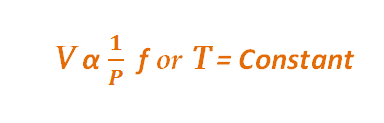
Where
- P denotes pressure of the gas
- V denotes volume of the gas
- K is constant and holds units of force times and distance.
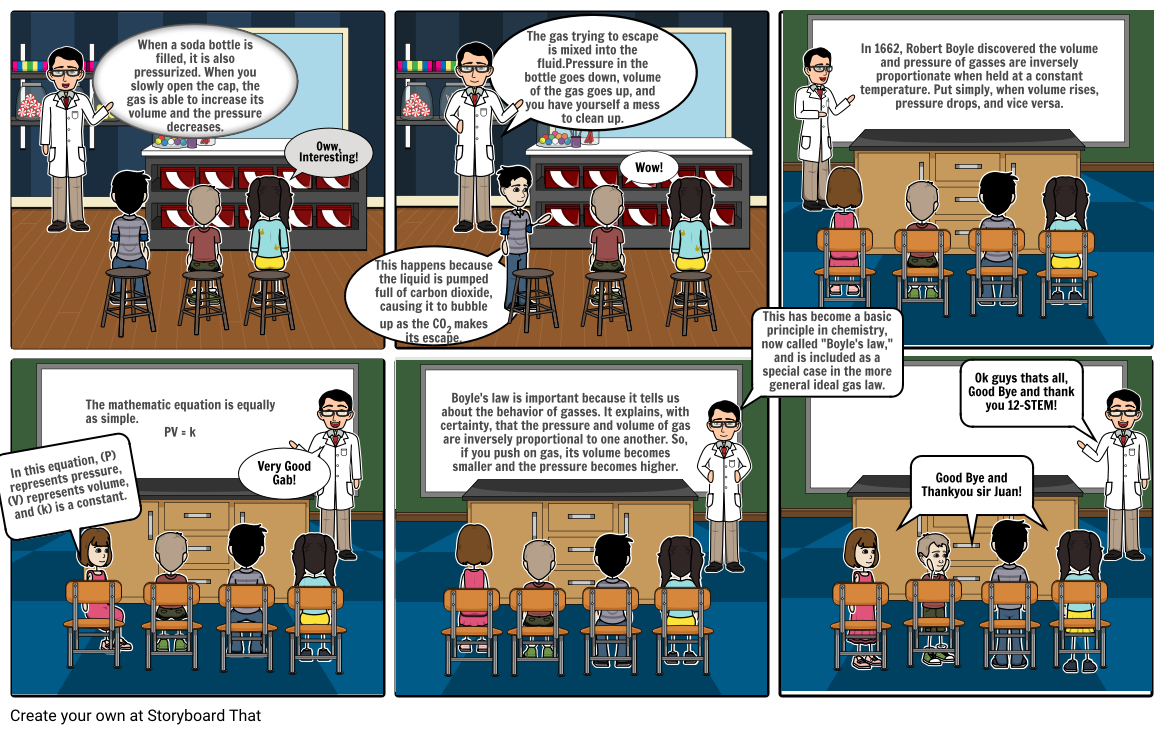

BOYLE ' S LAW FORMULA
According to this law, at a constant temperature, the product of pressure and volume is a constant:
PV = c
o
P ∝ 1/V
EXAMPLE FOR BOYLE ' S LAW PROBLEM
 | Boyle's Law |
 | pressure at state 1 |
 | volume at state 1 |
 | pressure at state 2 |
 | volume at state 2 |
(1) A 1 L volume of a gas is at a pressure of 20 atm. A valve allows the gas to flow into a 12 L container, connecting the two containers. What is the final pressure of this gas?
A good place to start this problem is to write out the formula for Boyle's law and identify which variables you know and which remain to be found.
The formula is:
P1V1 = P2V2
You know:
Initial pressure P1 = 20 atm
Initial volume V1 = 1 L
final volume V2 = 1 L + 12 L = 13 L
final pressure P2 = variable to find
Initial volume V1 = 1 L
final volume V2 = 1 L + 12 L = 13 L
final pressure P2 = variable to find
P1V1 = P2V2
Dividing both sides of the equation by V2 gives you:
P1V1 / V2 = P2
Filling in the numbers:
(20 atm)(1 L)/(13 L) = final pressure
final pressure = 1.54 atm

GRAPH FOR THE BOYLE ' S LAW
INTERPOLATION PART 2
DOUBLE INTERPOLATION
Usually used in the Superheated Steam Table.Must be used when two of the properties eg:Temperature and Pressureare are not tabulated in the Stream Tables


Usually used in the Superheated Steam Table.Must be used when two of the properties eg:Temperature and Pressureare are not tabulated in the Stream Tables
STUDENTS INFO
- https://www.youtube.com/watch?v=tNf38_ukNEE
- CAN GET NOTES FROM CIDOS (TOPIC 2)
- ASK LECTURE FOR MORE INFO
DONE BY DURGAASHINY D/O GUNASEKARAN 13DEM18F1018
INTERPOLATION
What is interpolation?
Interpolation is a method of constructing new data points within the range of
disceret set of known data points.


DISEDIAKAN OLEH: IZZATI NABILAH 13DEM18F1067
Interpolation is a method of constructing new data points within the range of
disceret set of known data points.
- SINGLE INTERPOLATION
DISEDIAKAN OLEH: IZZATI NABILAH 13DEM18F1067
Subscribe to:
Posts (Atom)